Things look a little different today, don’t they? For the first time since February 18th, Ash Wednesday, all the celebrations of Holy Week, Easter, Pentecost, Trinity Sunday, and Corpus Christi are over.
We’re back in green. Green vestments, green banners. That means we’re back to what the Church calls Ordinary Time.
When the Church says “Ordinary”, that doesn't mean boring. It's taken from the word “ordinal”, which means numbered.
So the Sundays in Ordinary Time are numbered, and this week is the Eleventh Week.
These are the Sundays where the Church teaches us how to live what we’ve just celebrated.
And how do we do that? How do we actually follow Jesus? How do we live as disciples in our ordinary lives?
Today, the Church gives some answers to those questions.
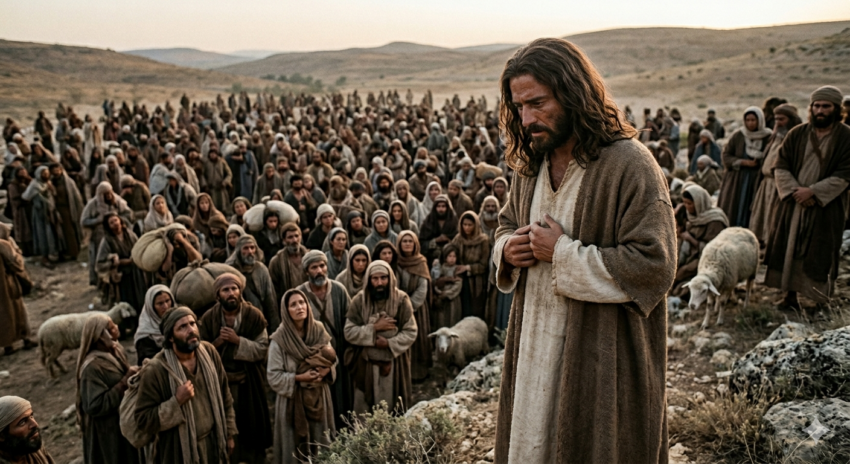
In the Gospel, Jesus looks at the crowds and sees people:
“Troubled and abandoned, like sheep without a shepherd.”
That line could describe our world today.
People feel troubled and abandoned. They're anxious. Lonely. Confused.
We see young people searching for meaning, families struggling, people carrying heavy, heavy crosses.
Jesus in the Gospel sees this same thing.
Amazingly, he didn't look at the crowds or look at us and say, “You guys sure have made a mess, haven’t you?”
Nope, he doesn’t complain. He doesn’t throw up His hands. He doesn’t blame society.
No, the Gospel says, “Jesus’ heart was moved with pity.”
Jesus sees hurting people and he's filled with compassion, so what does He do? He turns to twelve ordinary guys, names them his 12 Apostles, and basically says:
“Come help me love them.”
Ordinary, flawed men. Not celebrities. Not religious superstars. Not perfect saints.
Fishermen. A tax collector. A revolutionary.
Yet Jesus entrusted them with His mission. Why?
Because Jesus doesn’t call perfect people. He calls willing people.
There's a saying out there that:
“God doesn’t call the qualified. He qualifies the called.”
When you look at the Apostles, that certainly seems true.
These ordinary, imperfect men. Men who misunderstood Jesus, who doubted, who argued. Men who failed.
And yet Jesus looked at them and said:
“Come help me love them.”
And slowly, patiently, He formed them into his followers.
That should be encouraging to every one of us. Because sometimes we may think:
“Lord, I’m not holy enough.” “I don’t know enough Scripture.” “I don’t know everything about the Church.” “I’m a sinner.”
But God’s always worked through ordinary people. Peter denied Jesus. Matthew had a messy past. Paul persecuted Christians.
And still, God used them all.
Because God doesn’t call the qualified. He qualifies the called.
Today, God still says to us, “Come help me love them.”
In every generation, God has raised up: faithful disciples. Ordinary people willing to help Jesus love His people.
In our first reading from Exodus, God tells Israel:
“You shall be to me a kingdom of priests.”
So what does God mean by that?
A priest is someone who helps bring people to God and offers sacrifice.
Through Baptism, every Christian shares in what the Church calls the common priesthood of the faithful—our baptismal share in Christ’s priesthood.
Now let me be clear: that doesn’t mean everyone is a priest like Father standing at the altar.
The Church makes an important distinction between the ordained priesthood and the common Baptismal priesthood. Only ordained priests celebrate the sacraments and consecrate the Eucharist.
So, please don’t show up next weekend to Mass, bump Father out of the way and say, “It’s ok, we don’t need you today. I’ve got this.”
But it does mean that every baptized Christian is called like our priests to help bring people to God and offer spiritual sacrifices.
And what do those sacrifices look like?
Sometimes they look pretty ordinary.
Time spent caring for a loved one. Patience when you’re exhausted. Forgiveness when someone hurts you. Prayer when you don’t feel like praying.
Sometimes holiness looks less like stained-glass windows and more like sitting beside a hospital bed… making a meal for someone hurting, changing a diaper, bringing your kids or grandkids to Mass, praying for them when they drift.
That’s part of our baptismal priesthood. That’s part of being one of the disciples God still raises up today.
And the beautiful thing is this: God doesn’t send us out unprepared.
He forms us. He teaches us. He strengthens us.
Where does he do this?
Right here at every Mass – Jesus forms, teaches, and strengthens us when He speaks to us. Then He feeds us.
Which is why the Mass has two great parts:
First comes the Liturgy of the Word.
Notice what Jesus does first in today’s Gospel: He teaches. He proclaims. He speaks.
Someone once asked me why we process in with the Book of the Gospels? Why do we stand for the Gospel? Why is it such a big deal?
And the reason is, the Gospel isn’t merely information. It’s not just some cool stories about Jesus we listen to.
In a unique way, Christ speaks to His people in all the readings, but especially through the Gospel.
That beautiful cover isn’t just a decoration. It says: This matters. Pay attention. God’s speaking.
Have you ever wondered why we cover the chalice with a veil at the beginning of Mass?
It's because at the beginning of Mass, the Church wants our focus here—on the Word of God, not on the altar.
Before Christ feeds us in the Eucharist, He first speaks to us.
The veil quietly reminds us: Listen first. Receive the Word. Allow God to speak to your heart.
Then later, the veil comes off, and our focus shifts from the pulpit to the altar because the Mass moves from the Word to Sacrifice.
And what sacrifice is made present?
Listen again to St. Paul in Romans:
“While we were still helpless… while we were still sinners, Christ died for us.”
On the Cross, Jesus fulfills all sacrifices, and the beautiful thing is that Jesus didn’t wait for us to get our act together before dying for us.
He didn’t say: “Become holy and then I’ll love you.”
No. While we were sinners… Christ died for us. While we were wandering sheep. While we were broken. While we were weak.
He loved us. He suffered for us. He sacrificed Himself for us.
That - that becomes the definition of Christian love.
And at every Mass the one sacrifice of Jesus Christ, that one sacrifice of love, is made sacramentally present.
So today, the same Jesus who looked upon the crowds with compassion looks upon us with compassion.
He speaks to us, feeds us, heals us. And then—just like the Apostles—He sends us back out.
Because the mission didn’t end with the Twelve.
It continues through us.
Every Mass ends with a mission.
The priest or deacon has four choices for dismissing the congregation at the end of Mass.
“Go in peace.”
“Go and announce the Gospel of the Lord.”
“Go in peace, glorifying the Lord by your life.”
Or “Go forth, the Mass is ended.”
Go forth.
Go forth to our families. Go forth to our workplaces. Go forth to our neighbors. Go forth to our schools.
Go forth to the lonely, the hurting, and the forgotten.
That’s our mission. That’s our purpose in life.
Go forth.
Because Jesus still looks at us ordinary common people, us his disciples, and says:
“Go forth. And come help me love them.”