If anyone knows me, they can tell you I’m not a gardener. If a plant’s alive at our house, it’s because my wife watered it or God took pity on it.
But I know when a plant isn’t growing, you normally have to look at one of three things – the sower, the seed, or the soil.
In the First Reading, Isaiah reminds us God’s Word is like rain and snow coming down from heaven, making the earth fruitful and always accomplishing what He intends.
And in today’s Gospel, Jesus tells us the seed is God’s Word and the Sower is God Himself.
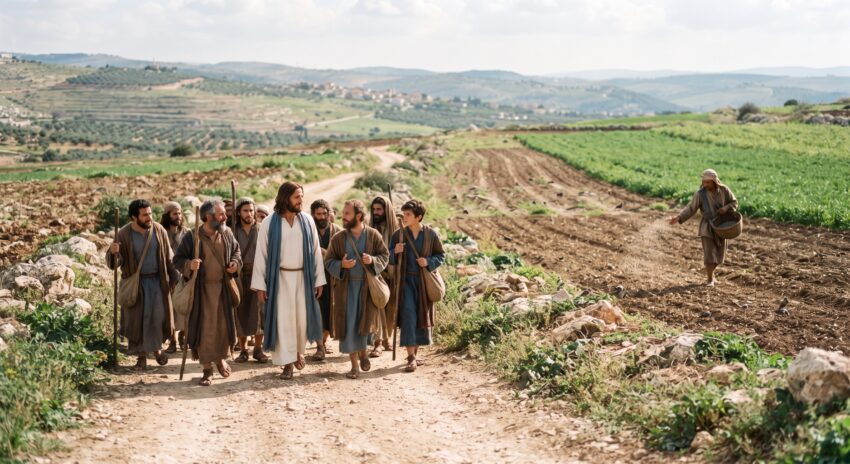
One of the things I love about this parable is the generosity of the sower. He goes crazy with the seed. He throws seed on the path, among the rocks, into thorn bushes, and onto good soil. A farmer today might call that wasteful.
But Jesus isn’t describing a careless farmer. He’s revealing the heart of God the Father.
God doesn’t save His grace only for people who have their lives together. He scatters it everywhere.
That’s the extravagance of God’s love and mercy.
He isn’t stingy. He keeps sowing. He never looks at a person and says, “You’re not worth another chance.”
The Christian life isn’t passive. It’s a spiritual battle. But God gives us everything we need to become saints.
So the seed and the Sower – they’re not the problem.
The problem is the soil.
The problem is our hearts and whether we’ll allow those seeds to accomplish something in us.
In this parable, Jesus shows the obstacles hindering our spiritual growth.
The first seed falls on the path. Jesus says this is the person who hears the Word, but doesn’t truly understand or receive it. The Word remains on the surface, and the evil one steals it away.
A Gospel touches us on Sunday, and we think, “I really needed to hear that.” But then we never reflect on it, pray with it, or let it sink in. By Monday, the message is gone.
The seed never took root.
Then Jesus says there’s the rocky soil. The seed springs up quickly, but when it gets hot, it withers because it has no roots.
We get excited about our faith. Then suffering or difficulties come, and we discover how shallow our roots really are.
Jesus isn’t saying suffering means our faith has failed. He’s telling us suffering reveals where our roots still need to grow.
Then there’s the seed among thorns. Jesus says the worries of the world and the lure of riches choke the Word.
Notice He doesn’t say the thorns are always terrible sins. Sometimes they’re simply crowded lives.
Work, events, worries — even good things like vacations — can crowd Jesus out until His Word no longer bears fruit.
Finally, there’s the person who hears God’s Word, understands it, and allows it to change the way they live.
In all of this parable,Jesus isn’t teaching us a gardening lesson. He's revealing how God works in every human heart.
Because if Jesus stopped the parable there, we'd probably leave a little discouraged.
We may say to ourselves, "OK, I’m either the hard path, the rocky ground, or the thorny soil. How am I gonna make the changes to be fertile soil?"
And the answer is: you can’t.
But God can.
God, the sower, can break open hard ground, remove rocks, and pull the weeds in your heart.
And that brings up a question?
If God’s working on us – because he always is – what do we do when we don't feel like we're changing?
That's where today's Second Reading speaks to us.
St. Paul says "creation awaits with eager expectation... We know that all creation is groaning in labor pains even until now."
Paul doesn't say creation’s dying. He says creation’s groaning.
There's a tremendous difference.
When a woman is in labor, she groans—not because life’s ending—but because new life’s about to begin.
Paul’s telling us this is often what the Christian life looks like.
We hear God's Word. We try to pray. We struggle against sin. We keep coming to Mass. We keep trying to love.
And sometimes it feels nothing’s changing. We groan.
But God’s still working beneath the surface. He’s always tilling the soil.
That's why one of the greatest spiritual battles we face isn't just temptation.
It's discouragement.
Discouragement tells us things like, “You’ll never change.” “Your prayers aren’t working.” “God’s not listening.”
But those are lies.
Jesus says, “Come, follow Me.” “Begin again.” “With Me, all things are possible.”
When we’re discouraged we can take comfort in what St. Teresa of Calcutta said, “God hasn’t called us to be successful. He’s called us to be faithful.”
Our job is faithfulness.
Sometimes we feel distant from God in prayer, and we think we’re doing something wrong.
We think if we’re close to God, prayer should always be uplifting. We should always feel His presence.
But that’s not how prayer—or love—works.
A good marriage isn’t built on constant emotion. It’s built on faithful love.
The same’s true of our relationship with God.
It’s not built on what I’m feeling.
Some days prayer’s filled with His presence. But many days, it feels like He isn’t here.
But God’s silence isn’t God’s absence.
Sometimes He’s growing our deepest roots beneath the surface.
A tree doesn’t grow deep roots because it rains every day. Roots grow deepest when they search for water beneath the surface.
The same’s true of faith.
That’s why we don’t measure our spiritual progress by our feelings.
We measure it by faithfulness.
Faithfulness in prayer.
Faithfulness at coming to Mass.
Faithfulness in forgiving.
Faithfulness in loving the Lord even when we don’t feel anything at all.
Our job is to cooperate with His grace.
Come to Mass. Pray. Go to Confession.
Forgive. Love.
Because God’s still sowing.
Today in this Mass, in the Liturgy of the Word, He scatters the seed of His Word into our hearts.
Then, in the Liturgy of the Eucharist, He does something more consequential.
He gives us the Word made Flesh.
The One who told this parable, the Divine Sower, will place Himself into our hands and upon our tongues.
Every Mass is another opportunity to allow God to cultivate the soil of our souls.
If we let Him, nourished by His Body and Blood, He’ll soften hardened hearts, remove the rocks that keep us from trusting Him, pull the weeds that have crowded Him out, and deepen our roots so when suffering or disappointment come, we’ll remain strong.
Not because we’re extraordinary.
But because His grace is.
So when you come forward for Holy Communion today, don’t ask yourself, “Did I feel close to God this week?”
Ask yourself, “Was I faithful?”
Did I keep praying? Did I keep trusting?
Did I keep loving?
Jesus lets us know in today’s parable that God knows what He is doing.
He knows how to cultivate hearts.
He never stops sowing.
Never stops watering.
Never stops weeding.
The Sower’s faithful.
Because the seed’s good.
And none of us is hopeless soil.