Have you ever met someone… you know you know them, but you can’t put a name with their face?
One of the greatest blessings of my life is that I've come to know lots of people, young and old. And I see them regularly when I’m out.
My daughter once told me she was never going to Walmart with me again because I’d stopped and talked to fourteen people.
Sadly, as I’ve gotten older, sometimes I fail to recognize who the former student- now- grownup I’m talking to really is. It’s because I’m expecting to meet them as I remember them, but I now fail to recognize them because they’re coming to me in the way I’m not expecting.
It’s easy to do.
That’s the thread tying today's readings together.
God makes himself present.
And again and again, His people don't recognize Him in the way He’s come.
Our first reading takes place during a dark moment in the prophet Elijah’s life.
Just before this, Elijah had defeated and killed the false prophets of Baal.
There’s a saying that “no good deed goes unpunished”, and in Elijah’s case it’s true, because now Queen Jezebel wants him dead.
Running for his life, Elijah goes to Mount Horeb – where Moses encountered God in the burning bush centuries before.
God tells Elijah to stand on the mountain because "the Lord was passing by."
Elijah encounters a mighty wind, an earthquake, and fire.
But the Lord wasn’t in any of them.
Finally Elijah hears "a tiny whispering sound" — or, as another translation says, "the sound of sheer silence."
And Elijah recognizes he’s standing in the presence of God.
God hadn’t abandoned Elijah.
He just came in a way Elijah wasn't expecting.
In the Second Reading, Paul writes one of his most emotional passages:
"I have great sorrow and constant anguish in my heart."
Why?
Because many Israelites, his own people, failed to recognize Jesus as Messiah.
For centuries, God prepared the Jewish people for their Savior through Abraham, Moses, David, the prophets, and the Ten Commandments.
Then the Messiah finally came...and many never recognized Him.
Paul’s heartbroken.
He loves his people so much he wishes they could see what God’s already done.
Then there’s today's Gospel.
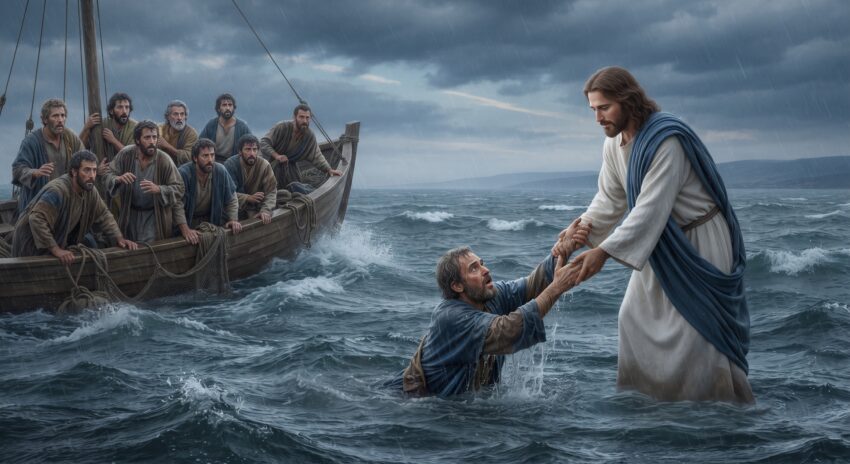
Jesus feeds over five thousand people, dismisses the crowds, sends the disciples rowing across the Sea of Galilee, and goes up the mountain to pray.
St. Augustine saw in this story the boat as an image of the Church sailing through the sea of this world. He saw the waves as the temptations and sufferings every Christian faces.
And notice where Jesus is while this is happening. He’s on the mountain praying. Though the disciples can’t see Him, He hasn’t forgotten them.
Augustine says this points to Christ, who has ascended to the Father and continually intercedes for us. He may seem absent sometimes, but He’s never uncaring.
During the night, the wind becomes stronger, the waves get rougher, and the disciples struggle to row.
Then, between three and six in the morning — Jesus walks toward them on the water.
This is a very important point that we might miss.
Matthew’s revealing who Jesus truly is.
In the Old Testament, only God walks on the sea. The Book of Job says God alone "treads upon the waves."
And what happens when Jesus does this?
The disciples don't recognize Him, thinking He's a ghost. He came in a way they weren’t expecting him.
Jesus says, "Take courage. It is I. Do not be afraid."
In the original Greek. Jesus says, *ego eimi* (eh-GOH ee-MEE) — which translates to "I AM" — the name God revealed to Moses at the burning bush.
So, in the storm, Jesus is revealing to us He’s the God who spoke to Moses and appeared to Elijah, standing right in front of the disciples.
Peter responds, "Lord, if it is you, command me to come to you."
Jesus says, “Come.”
Peter’s the only disciple with faith enough to climb out and start walking on the water.
But, then Peter noticed the wind.
And, he sank.
What was different?
The wind was there all along. The waves hadn't gotten bigger. The storm hadn't gotten worse. Nothing around Peter had changed.
What changed was where Peter was looking.
The moment his eyes left Jesus and became fixed on the storm, fear took over.
That's true in our own lives, too, isn't it?
We shift our focus off Jesus to a diagnosis, a family struggle, our grief, or some past sin. Like Peter, we lose focus and we feel like we’re sinking.
What these readings are asking us today is: Where are you looking? Are you fixed on Jesus? Do you recognize His presence in your life?
Elijah almost missed God because he expected fireworks. Many Israelites missed Jesus because they expected a fighting king. The disciples missed Him because they thought He was a ghost.
We can miss Him in the same way.
But how often do we miss Him because we don’t recognize Him in the way He’s come?
God often makes His presence known through the kindness of another person, beauty in creation, a Scripture verse, or a quiet moment of silence. These can be gentle reminders that He’s near.
But he also comes in a way more important.
Sometimes people say, "I wish God would give me a sign."
Well, He already has.
Others say, "I wish I could really experience God's presence."
You can. At every Mass.
In the First Reading, God revealed Himself in a whisper and in the Gospel, He revealed Himself walking upon the waters.
Today, He comes to us with humility.
Not in wind, or earthquake, or fire or walking across water.
He comes hidden in the appearance of ordinary bread and wine.
The greatest miracle on earth happens in silence.
No flashing lights. No dramatic music.
Just Christ’s words spoken through His priest:
"This is my Body."
"This is my Blood."
If someone without faith walks into Church at the moment of Consecration, they wouldn't think anything extraordinary had happened.
Yet heaven knows. The angels know. The saints know.
And we know.
Jesus Christ is truly present.
In the Eucharist, we don’t have to wonder. Christ has told us He is present — Body, Blood, Soul, and Divinity.
The same Jesus who whispered to Elijah... The same Jesus who walked across the sea… The same Jesus who stretched out His hand and saved Peter...is here.
He’s here.
Someone infinitely greater than wind, earthquakes or fire.
That’s why we come to worship. That’s why it doesn’t really matter if you “get” anything out of Mass. You’re here. You’re here because He’s here.
So bring Him your storms, your fears, your worries about your children, your health, your future.
And, like Peter, keep your eyes fixed on Him.
Because the greatest miracle isn't that Jesus walked on water.
The greatest miracle is that He comes to us, every day, at every Mass, giving us His Body and Blood, so no matter how fierce the storm becomes, we never have to face it alone.
When you recognize Christ’s already in your boat, you realize the question is no longer, 'How big is my storm?'
The question becomes, 'How close is my Savior?'
And the answer is this: close enough to place Himself into your hands and into your heart.
Do you recognize Him?