I’ve heard when Jesus told Peter you have to forgive someone 77 times, James turned to John and said, “Great… Not only do we have to forgive others, now we also have to do math.”
Suppose somebody owed you $100 billion. Not a million. Not a billion. A hundred billion dollars.
And suppose you looked at him and said, “You know what? Forget it. You don’t owe me anything.”
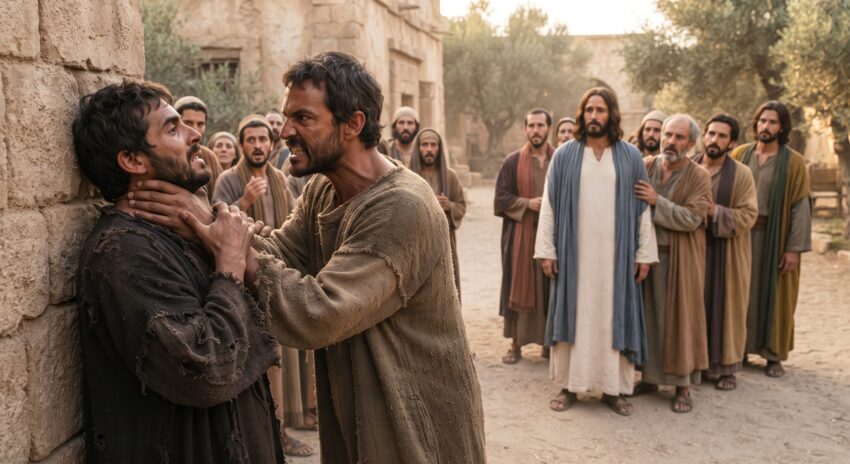
Then you watched that same man walk outside, find somebody who owed him a few hundred dollars, grab him by the throat, and demand every penny.
You’d probably think, “What’s wrong with him?”
Well…Jesus tells us that story today.
And the uncomfortable part is: **we’re that guy.**
Peter comes to Jesus with what probably sounded like a generous offer.
“Lord, if my brother sins against me, how often must I forgive? Seven times?”
To understand Peter’s question, it helps to know that Jewish teaching in Jesus’ time held that someone was obligated to forgive an offender three times.
After that, you weren’t obligated to forgive.
So Peter doesn’t say three. He says seven.
He probably expected Jesus to pat him on the back and say, “Peter, now you’re getting it.”
Instead Jesus says, “I say to you, not seven times but seventy-seven times.”
In other words: “Quit counting.”
Then Jesus tells a story.
A king settles accounts with his servants. Our translation says one guy owes him “a huge amount.” But the original text is much more specific: ten thousand talents.
To Jesus’s audience, that would have sounded outrageous.
Ten thousand talents back then was an astronomical amount of money. A talent was roughly $1 million today. Depending on how you try to calculate it into today's dollars, we’re looking at tens of billions of dollars.
The exact figure isn’t the point. Jesus chose an amount so enormous everybody listening to him knew: “this man’s never paying it back.”
Ever.
Yet the servant says, “Be patient with me, and I will pay you back in full.”
Sure you will.
He can’t pay it back.
So what does the king do?
He doesn’t put him on a payment plan or reduce the interest rate. The Gospel says the master was “moved with compassion and forgave the entire debt.
Ten thousand talents.
A hundred billion dollars.
Gone.
The size of the debt tells us something about sin.
But the cancellation of the debt tells us something even greater about God.
As our Responsorial Psalm states, “The Lord is kind and merciful.”
Sirach prepares us for this in our first reading: “Forgive your neighbor’s injustice; then when you pray, your own sins will be forgiven.”
And Jesus taught us in the fifth Beatitude: “Blessed are the merciful, for they will be shown mercy.”
That’s all good, but then the parable takes a disturbing turn.
The servant walks out and finds another servant. Our translation says he owes “a much smaller amount.” The original text says one hundred denarii—roughly one hundred days’ wages.
Now, that amount wasn’t nothing. It was a real debt.
**That matters.**
Jesus isn’t saying the hurt people cause us isn’t real.
Betrayal matters. Cruelty matters. Injustice matters.
The debt the man owed the first debtor is real.
But compared with what this servant has just been forgiven, it’s tiny.
And what does he do?
He grabs the man by the throat: “Pay back what you owe.”
The second servant begs, “Be patient with me, and I will pay you back.”
Does that sound familiar?
It’s almost the exact same plea the first servant made.
But this time there’s no mercy.
And that’s where this stops being a story about two servants a long time ago and becomes a story about **you and me.**
We love receiving mercy.
We’re glad God’s patient with us. We’re glad he gives us another chance.
When we say sorry to God, he doesn’t say, “Nope. That was number eight. You used up your seven.”
God doesn’t count like that.
But then somebody hurts us.
Somebody betrays our trust. Somebody disappoints us.
Somebody wounds us deeply—and sometimes we carry that wound for years.
Then giving mercy can be another matter.
Suddenly **we start counting.**
So what does it actually mean to forgive?
Let's talk first about what forgiveness ISN'T.
Forgiveness doesn’t mean pretending something didn’t happen.
It doesn’t mean calling evil good.
It doesn’t mean trust is automatically restored.
It doesn’t always mean the relationship can go back to the way it was.
And it doesn’t mean remaining in an abusive or dangerous situation.
Forgiveness means something deeper.
**It means I refuse to allow somebody else’s sin define my life.**
It means I surrender my claim to hatred and revenge.
It means I stop giving that person’s actions control over my heart.
And sometimes that’s really hard.
Sometimes forgiveness begins not with a feeling, but with a decision.
Maybe our prayer sounds like this:
“Lord, I don’t feel like forgiving this person. I don’t even know how. But I want to want to forgive them. You’ll have to start there.”
And God can start there.
The Catechism reminds us how serious this is. Every time we ask the Father, “Forgive us our trespasses as we forgive those who trespass against us,”...
We're asking God’s mercy to change not only our relationship with him, but our relationship with those who hurt us.
Does that mean forgiveness is easy?
No.
But I think we have to take a look at Jesus.
From the Cross, while the nails were still holding him there against the wood, Jesus prayed, “Father, forgive them.”
That’s forgiveness. That’s mercy without limits.
And St. Paul reminds us today: “Whether we live or die, we are the Lord’s.”
**We belong to Christ.**
And if we belong to Christ, we don’t have to carry our wounds alone. We can bring him the anger, disappointment, betrayal, and resentment.
And the great news is we can bring our own sins to him in Confession.
Think about what happens there.
Like the servant in the story, we come before God carrying a debt there’s no way we can erase ourselves. We confess it. We tell him we’re sorry.
And Jesus doesn’t say, “Let’s work out a payment schedule.”
Through the ministry of his priest, Christ says:
**“I absolve you.”**
Your debt – forgiven.
Ten thousand talents.
Gone.
**People who know how much they’ve been forgiven learn how to forgive.**
Maybe, as you’ve been listening, somebody’s name has come to mind.
Maybe there’s a wound you’re carrying. Maybe there’s a resentment you’ve held so long you hardly notice it anymore.
You don’t have to pretend the hurt wasn’t real. And you don’t have to fix everything today.
Just bring that person to Jesus.
“Lord, you know what happened. You know how much it hurt. But I don’t want this wound to own me anymore. You have forgiven me more times than I can count.
Teach me how to forgive.”
**(PAUSE)**
Maybe that’s where forgiveness begins.
Not by forgetting what happened.
Not by pretending it didn’t hurt.
But by remembering how much mercy God has already shown us—and asking him for the grace to show that mercy to someone else.
Because in the end, Jesus isn’t asking us to keep count.
He’s asking us to become merciful.
And in just a few moments, we’ll come again to this altar—not because we’ve earned God’s mercy, but because we need it.
And when we leave this church today, Christ asks us to carry some of that mercy with us.
Into our homes.
Into our families.
And maybe even to that person whose name came to mind a few moments ago.
For after all:
“The Lord is kind and merciful.”